Proving AI ROI to the board: low-hanging, high-impact AI use cases for global occupier services
If you've sat through a board meeting in the last year, you've probably heard some version of this question: "We're spending money on AI — where's the return?"
You're not alone in struggling to answer it. According to JLL's Global Real Estate Technology Survey of more than 1,000 senior decision-makers, 92% of occupiers and tenants have already started AI pilots. But only 5% of firms report achieving most of their AI program goals. Many say they're still strategically, organizationally, and technically unprepared to execute on what they've started. The money is moving — most firms are increasing AI-specific technology budgets — but the results aren't keeping pace with the investment.
The discipline that actually drives ROI: doing less, on purpose
Gabriel Safar, Managing Director | Real Estate and the Built Environment at Proxet, made a point that's worth borrowing: cost and time in these projects come down when real estate organizations resist the instinct to connect and integrate everything up front, and instead start with one specific business question they actually need answered.
Organizations often want to skip the "hard business work" of defining the question and jump straight to a data project. As Gabriel puts it:
"Organizations need to do the intellectual hard work of figuring out exactly what strategic questions they need to answer and why it matters to their business. And I find a lot of companies don't want to do that work. They just want to say, 'Give me an answer. I want to do a data thingamabob and just tell me what to do.' And the response is, 'Sorry, it doesn't work that way.'"
That instinct to hunt for a magic comprehensive "thingamabob" is exactly backwards. The expensive, unglamorous part of most AI initiatives are the connectors and integrations built to feed it. And the real kicker — not all of it is required! Once you narrow the scope to a real, specific business question, you might realize a massive portion of that complex technical plumbing wasn't just a headache — it was completely unnecessary. You risk burning months of budget building infrastructure you didn't need to solve the problem.
For a GOS team, that's a practical filter for tech investments. Before greenlighting a massive platform overhaul, the question isn't "how do we integrate our lease admin system, our IWMS, our helpdesk, and our sensor data all at once?" It is "what's the one problem — for example: which leases have renewal options expiring in the next 90 days — that we can solve fast, with the data we already have?"
Gabriel's advice is to focus on putting points on the scoreboard early rather than waiting for a comprehensive enterprise build. That's the difference between a board that sees a working pilot in eight weeks and a board that looks at a budget line item with zero output for a year.
AI use cases for GOS: from quick wins to long-term investments
With that "narrow the scope" filter in mind, here is how GOS teams can realistically evaluate their AI opportunities — from the immediate quick wins to the heavier infrastructure plays:
Lease abstraction and administration
AI extracting highly complex financial obligations — like controllable OpEx caps and base year stops — alongside standard critical dates and renewal options at scale. This is the easiest ROI story in the portfolio, since your data source already exists as localized PDFs or Word files, so you don't need a massive data-cleansing project just to get started. AI securely transforms messy legalese into structured data that flows directly into your existing tracking systems without a single manual copy-paste, giving you immediate audit readiness and thousands of hours saved.
- Level of Effort: Low
- Time to Value: 2 to 4 weeks (Pilot/First Batch); 1 to 2 months (Full Portfolio)
- Data Dependency: Unstructured and semi-structured documents — PDFs, scanned images, or Word files of core leases, amendments, riders, and commencement letters
Facilities helpdesk and work order triage
While a manual helpdesk feels like a minor admin cost, the downstream mistakes — wrong vendor trip fees, blown SLAs, and garbage data logging — quietly bleed your budget. You don't need any onsite building hardware — no physical sensors to mount or gateways to wire. AI simply sits on top of your existing ticketing inbox or CMMS via standard APIs, instantly reading and automating accurate routing to eliminate administrative friction and wasted vendor spend.
- Level of Effort: Low to Medium
- Time to Value: 1 to 2 months
- Data Dependencies: Historical and active text-based work order logs from your CMMS/IWMS (e.g., Maximo, ServiceChannel, ServiceNow)
Transaction and market intelligence
AI-assisted comps, renewal risk flagging, and deal pipeline forecasting for large occupier portfolios.
- Level of Effort: Low to Medium
- Time to Value: 2 to 3 months
- Data Dependency: Internal CRM data (e.g., Salesforce, VTS, HubSpot) combined with third-party real estate market data feeds via API (e.g., CoStar, LightBox, Cherre, or local brokerage data)
Lease accounting compliance (ASC 842 / IFRS 16)
Automated flagging of reporting discrepancies across large, multi-entity portfolios. This speaks directly to the risk-and-compliance instincts of board members who care about exposure and risk.
- Level of Effort: Medium
- Time to Value: 3 to 6 months
- Data Dependencies: Structured lease financial schedules (base rent, escalations, parent/subsidiary relationships) paired directly with General Ledger (GL) data and ERP accounts payable records (e.g., SAP, Oracle, NetSuite)
Space utilization and portfolio right-sizing
AI analyzing badge, sensor, and Wi-Fi data to flag underused space and inform occupancy planning. This ties directly to hard-dollar savings: reduced footprint, lower cost-per-seat.
- Level of Effort: High
- Time to Value: 3 to 6 months (If using existing Wi-Fi/badge logs); 6 to 12 months (If deploying new IoT hardware)
- Data Dependencies: Network authentication logs (e.g., Cisco DNA Spaces, Catalyst Center or Aruba Wi-Fi traffic), physical access security records (badge swipe data from systems like Lenel or S2), and cloud APIs from dedicated occupancy hardware (e.g., Density, VergeSense)
ESG and sustainability data aggregation
Automated roll-up of energy, emissions, and utility data across hundreds of leased locations — increasingly a board-level reporting requirement.
- Level of Effort: High
- Time to Value: 6 to 12 months
- Data Dependencies: Highly fragmented utility consumption data (electricity, water, gas invoices), real-time smart meter interval data, landlord pass-through expense reports, and localized Scope 1, 2, and 3 emission databases
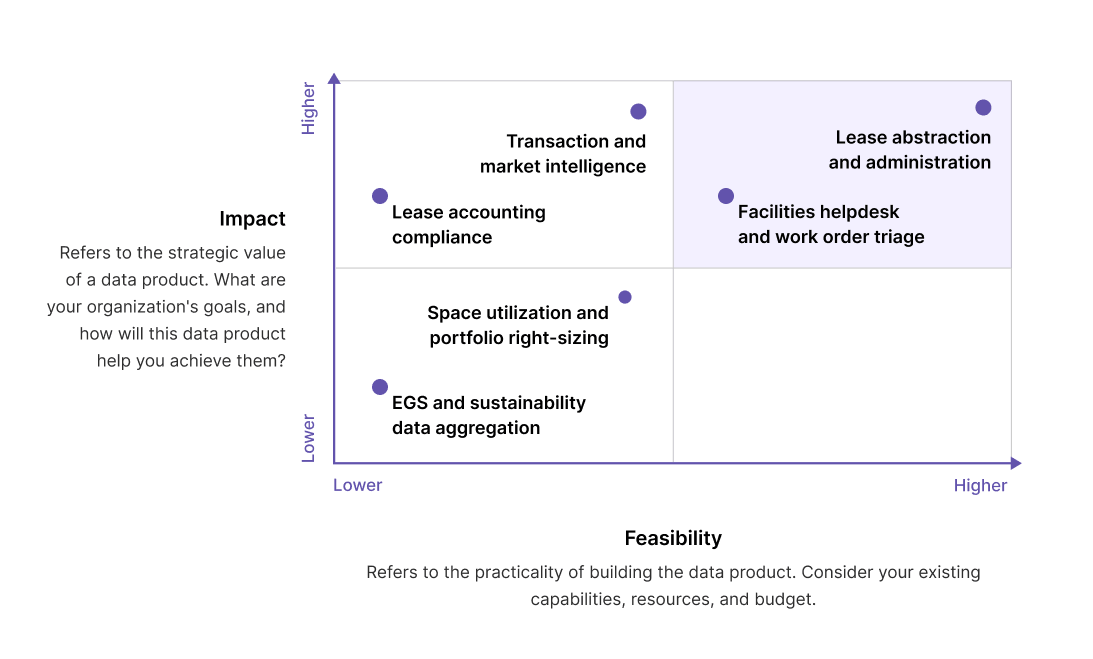
Notice the pattern: while some of these (like space utilization and ESG) require deeper data pipelines, they all allow you to target a narrow, specific question rather than forcing an enterprise-wide technology overhaul.
And to be clear, it is entirely possible to beat the Time to Value timelines we've listed above by simply purchasing an off-the-shelf point solution. But there is a very specific reason JLL's survey found that only 5% of AI initiatives actually achieve their goals. Buying standalone, out-of-the-box tools without a strategy for your underlying data infrastructure just creates new, isolated silos.
That said, the absolute worst move a GOS leader can make right now is to freeze and do nothing at all. You don't need to completely fix your legacy IT infrastructure to start extracting massive value from your lease files or helpdesk queues today.
Making your case to the board
Boards don't need to understand the model architecture. They need to see the number move on something they already track. Three buckets tend to land:
- Cost avoidance or reduction: hours saved, footprint reduced, vendor spend down
- Risk reduction: compliance exposure, missed deadlines, audit findings
- Client or employee experience: SLA performance, retention, satisfaction
Pick one use case, one metric, one before-and-after comparison. Prove it. Then use what you learned — what data you actually needed, what you didn't — to make the next one faster and cheaper to run. That's not a slower path to enterprise-wide AI. Industry data suggests it's the only path that's actually working right now.
Where to start
You don't need to have all six use cases mapped out before you move. Look at your current portfolio goals. Chances are, one of the use cases mapped out above aligns with a problem you are already trying to solve.