Think "Data Maturity" is already obsolete? Think again.
Agentic AI cannot exist without its data backbone.
Generative AI has completely uprooted the traditional ways we think about managing and processing enterprise information. Because modern AI can read unstructured PDFs (most of the time), write its own code (sometimes accurately), and infer context (decently well), it feels like the old, linear checklists for building pristine data architectures are completely obsolete.
But don't rush to completely abandon the foundation of assessing your organization's data maturity and AI readiness.
If you focus exclusively on AI, you forget that it’s not only about AI.
You risk chasing yet another shiny object without learning how to leverage one of your organization's most valuable assets: its data.
Where do you start - even if you’ve been on this data journey for a while?
It is essential to assess your organization’s data maturity — the measure of how effectively your business leverages data to drive strategic decisions.
What is data maturity?
The Data Maturity Model serves as a strategic roadmap, helping organizations:
- Assess current data capabilities.
- Benchmark against peers and competitors.
- Identify growth opportunities.
- Set clear, realistic goals for data-driven initiatives.
- Prioritize investments and allocate resources effectively.
This structured approach clarifies where a company stands, where it wants to go, and how to get there. There’s no right or wrong place to be on the data maturity scale; what matters is aligning your objectives with business needs and building a roadmap for progress.
The data maturity model
To effectively use data, organizations must understand how it’s obtained, interpreted, and managed. Assessing data maturity helps businesses identify what they can realistically achieve across three primary stages:
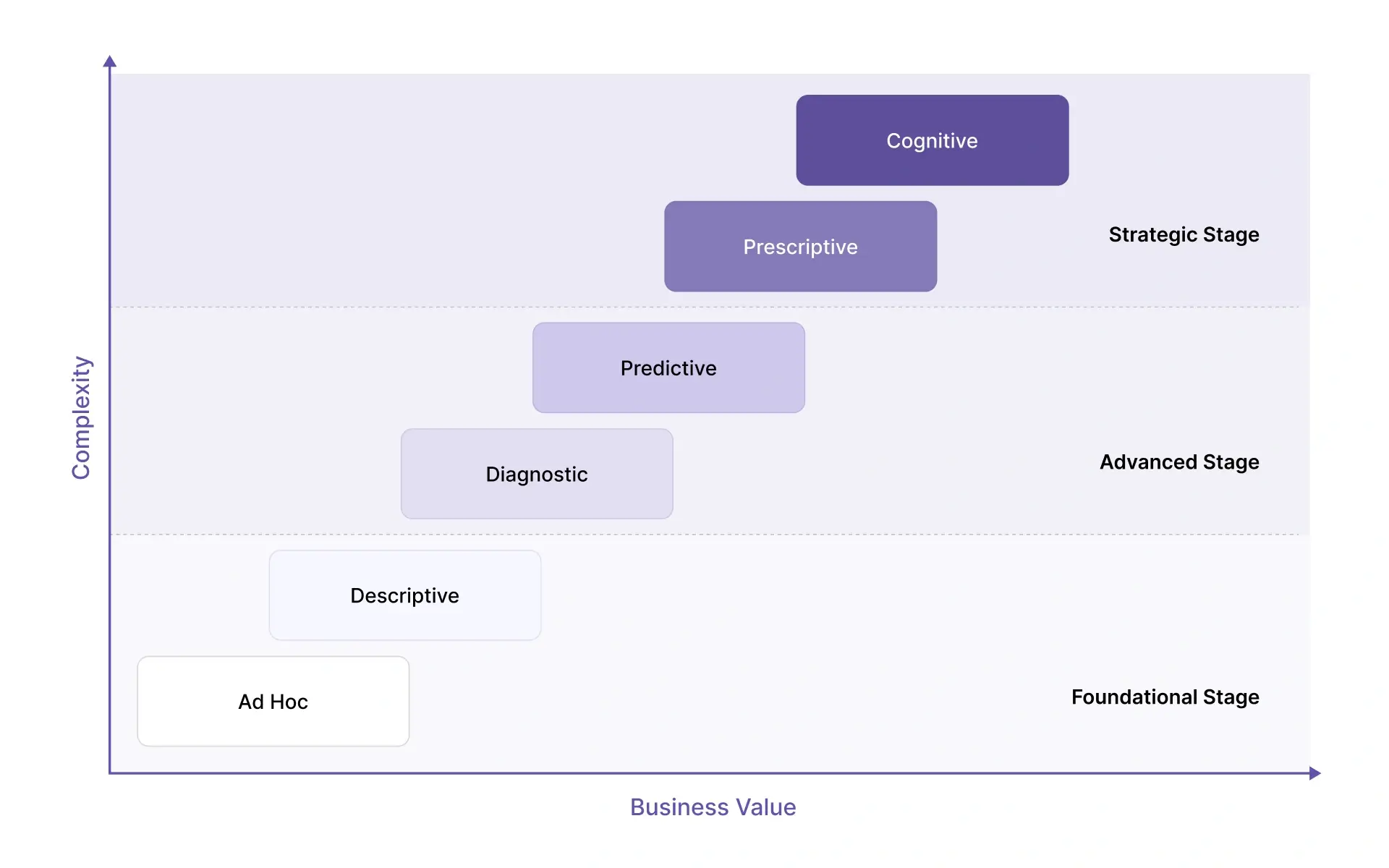
Stage 1: The Foundational Stage
This is the beginning of any company’s journey. Foundational Stage companies use their data to understand business insights, visualize trends, and analyze historical data.
This stage is characterized by ad-hoc reporting and basic descriptive analytics. While reports offer some insights, they may not provide a big-picture view or align seamlessly across various sources and tools.
Traits of Foundational Stage Data:
- Ad-hoc: Responding to specific data requests on an as-needed basis. While useful for quick answers, it can be inefficient and time-consuming.
- Descriptive: Summarizing and describing data to understand what has happened in the past.
Examples of Initiatives:
- Enterprise Reporting: Consolidates data from multiple business units (Financial, CRM, and operational databases) to provide a unified view.
- Asset-level Reporting: Tracks the performance of individual assets against budgets, including usage and maintenance costs.
Opportunities to Mature:
- Break Down Data Silos: Gain a more complete understanding of operations to identify improvements.
- Monitor Asset Performance: Identify underutilized assets and optimize maintenance schedules.
Stage 2: The Advanced Stage
At this stage, data analysis is a regular part of every team’s operation. Organizations delve deeper to understand what’s happening, why it’s happening, and what could happen in the future.
Traits of Advanced Stage Data:
- Diagnostic: Analyzing data to identify the root causes of problems or trends.
- Predictive: Using data to forecast future outcomes, such as property values, market trends, or rental demand.
Examples of Initiatives:
- Self-Serve Analytics: Using tools like Sigma BI to enable users to work directly with live data through Excel-like models.
- Tenant Risk Modeling: Analyzing payment history and lease obligations to assess the likelihood of default.
- Market Intelligence: Leveraging Snowflake to access public data (like S&P Global) for competitor portfolio insights.
Opportunities to Mature:
- Diagnostic Level: Expand data ecosystems with real-time economic indicators and implement automated risk dashboards for management.
- Predictive Level: Use continuous feedback loops from real-world tenant behavior to refine models.
- Predictive Maintenance: Use sensor data and logs to predict equipment failures before they occur, reducing downtime.
Stage 3: The Strategic Stage
At the final stage, companies operate at the cutting edge of innovation. Strategic companies have the technology to answer questions others haven’t even thought about asking. By analyzing real-time data, they make forward-looking decisions about products, markets, assets, and staffing.
Traits of Strategic Stage Data:
- Prescriptive & Executive: Beyond just recommending specific actions, the data environment now supports autonomous execution. Data environments do more than recommend; they execute. Instead of just flagging a supply chain gap, autonomous agents negotiate terms and trigger purchase orders across platforms to meet strategic goals instantly..
- Cognitive & Autonomous: AI agents handle complex, multi-step tasks with minimal help. Instead of staff doing the heavy lifting or approving every single step, leadership simply sets the goals and monitors the results. The AI manages the day-to-day tactics and analysis, allowing humans to focus on the big picture.
Examples of Initiatives:
- Automated Deal Evaluation: Using AI to process property listing data (location, price, market trends) and drive recommendations to scale acquisition programs.
- Sensitivity Analysis: Simulating large-scale changes, such as interest rate hikes or recessions, to model impacts on investment values.
Opportunities to Mature:
- Automated Deal Screening: Use AI to scan and flag opportunities based on investment goals.
- Macroeconomic Scenario Modeling: Run "what-if" analyses on inflation and interest rates to protect portfolio performance.
- Closing the Execution Gap: Move from "insight to action" by allowing AI agents to handle the manual coordination between systems (e.g., updating the ERP based on a cognitive lease summary).
- Continuous Optimization: Enable systems that self-correct in real-time, such as autonomous HVAC adjustments or dynamic rent pricing that reacts to live competitor data.
While the "Strategic Stage" is where Agentic AI becomes a core business philosophy, Advanced Stage companies can use it as a "fast-track" accelerator to bridge the gap between predicting the future and actually executing it.
How advanced stage companies benefit now
At the Advanced Stage, you are already doing Predictive and Diagnostic work (e.g., "We know this tenant might default" or "We know this HVAC will fail"). Agentic AI allows you to move from knowing to responding without waiting for the Strategic Stage to be fully "mature."
From Prediction to Prevention: If your predictive model flags a potential equipment failure, an AI Agent can automatically check the warranty, find an available technician, and draft the service order for a human to hit "Approve."
Benefits of progressing through the maturity scale
Making small, consistent strides in data maturity leads to:
- Better decision-making: More informed and effective choices through optimized tools.
- Increased efficiency: Cost savings through automation and streamlined processes.
- Enhanced customer experience: Personalized interactions and best-in-class service.
- Competitive advantage: A data-driven approach that differentiates your organization.
The traditional, linear checklists of the past have evolved, but the core truth remains: you cannot successfully automate or predict what you do not understand. By knowing exactly where you stand on the maturity scale, you gain the strategic roadmap needed to invest wisely, bridge the gap between insight and autonomous action, and ensure your business isn't just surviving the AI revolution — but leading it.